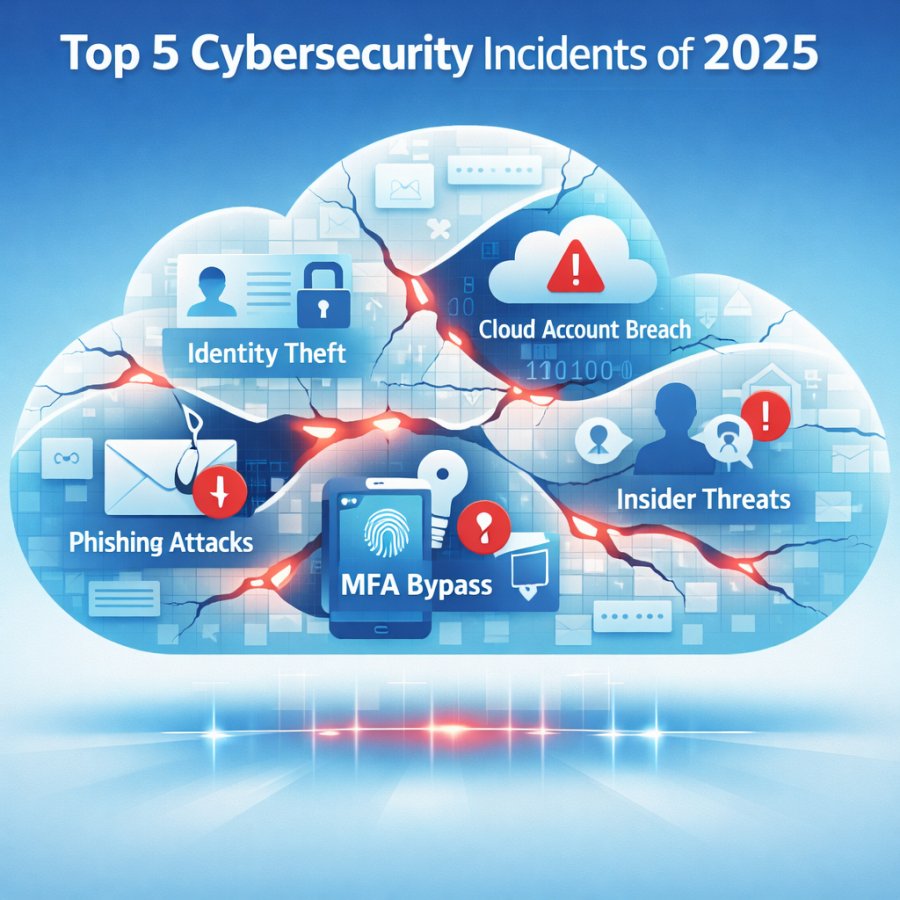
1. Cloud Identity Attacks on Microsoft Ecosystems Changed Everything
In 2025, some of the most damaging enterprise breaches happened without malware, exploits, or suspicious files. Instead, attackers focused on cloud identity layers inside environments built on Microsoft services.
They abused:
-
OAuth tokens that never expired
-
Over-privileged admin roles
-
Misconfigured conditional access policies
-
Dormant service accounts no one remembered creating
Once attackers gained access, they didn’t rush. They observed. They learned business processes. They blended in with IT admins and automation jobs.
Many security teams were still thinking in terms of endpoints and antivirus alerts. Meanwhile, attackers were operating entirely in the cloud.
Why this shook companies:
There was nothing to “detect” in the traditional sense. Logins were valid. Actions were permitted. Everything looked normal.
The hard lesson from 2025:
If your identity layer is compromised, every other control becomes irrelevant.
Identity is no longer part of security. Identity is the control plane.
2. Healthcare Breaches Reached a Breaking Point
Healthcare has always been a favorite target, but 2025 pushed it to a new level. Breaches connected to UnitedHealth Group and its wider ecosystem showed how fragile large, interconnected industries really are.
What made 2025 different was the impact:
-
Claims processing systems went offline
-
Pharmacies couldn’t validate prescriptions
-
Hospitals struggled with operational continuity
-
Sensitive patient data surfaced months later on underground forums
In many cases, attackers didn’t breach the main organization directly. They entered through small vendors, billing partners, or third-party service providers with minimal security budgets.
Why this shook companies:
The damage wasn’t just reputational. It was operational. People couldn’t get care. Businesses couldn’t function.
The hard lesson from 2025:
Your security posture is only as strong as your least mature vendor.
Third-party risk is no longer a checkbox. It’s existential.
3. Snowflake Customers Lost Data Without a “Hack”
This incident confused many executives at first. Headlines spoke about data loss involving Snowflake customers, but Snowflake itself wasn’t breached.
Attackers used:
-
Stolen usernames and passwords
-
Credentials harvested from old breaches
-
Access reused across multiple platforms
They logged in legitimately and quietly downloaded massive volumes of sensitive data from customer environments.
No malware. No vulnerability exploitation. No alerts screaming breach.
Why this shook companies:
Security teams realized their detection models were built around attacks that break rules. This attack followed the rules perfectly.
The hard lesson from 2025:
The cloud does not protect you from poor credential hygiene.
If attackers have valid access, the cloud assumes they belong there.
4. Remote Access Tools Became the Perfect Disguise
Remote administration tools have always been double-edged swords. In 2025, attackers mastered their abuse.
Tools similar to AnyDesk, along with other legitimate IT utilities, were used to:
-
Maintain long-term access
-
Perform actions during business hours
-
Avoid triggering security alerts
-
Look indistinguishable from internal IT staff
From a SOC’s perspective, everything appeared normal. There were no suspicious processes, no strange network traffic, no malware signatures.
Why this shook companies:
Security teams realized attackers weren’t hiding anymore. They were camouflaging themselves as trusted operators.
The hard lesson from 2025:
If your monitoring cannot distinguish between “authorized” and “appropriate,” attackers will always win.
5. AI-Driven Phishing Finally Outsmarted Humans
Phishing has existed for decades, but 2025 marked a turning point. AI made phishing personal, contextual, and convincing.
What companies saw in 2025:
-
Emails matching executive writing styles
-
Messages referencing real meetings and projects
-
Voice calls cloning CEOs or CFOs
-
Urgent payment or access requests timed perfectly
Even experienced employees fell for it. Even trained finance teams approved fraudulent transfers.
Why this shook companies:
Security awareness programs built around spotting bad grammar and suspicious links simply stopped working.
The hard lesson from 2025:
When AI targets human trust, technology alone cannot stop the attack.
Process and verification matter more than ever.
What 2025 Really Taught Companies
If you step back and look at all five incidents, a pattern becomes obvious.
Attackers in 2025 didn’t rely on:
-
Zero-day exploits
-
Complex malware
-
Loud ransomware campaigns
They relied on:
-
Trust
-
Identity
-
Vendors
-
Human behavior
-
Legitimate tools
Most companies that suffered in 2025 already had security tools. Firewalls, EDR, SIEM, MFA. The tools weren’t missing.
The visibility was.
Why Traditional Security Thinking Failed
For years, cybersecurity focused on preventing entry.
In 2025, attackers proved that entry is easy.
The real challenge is answering:
-
Who is accessing what?
-
Does this access still make sense?
-
Is this behavior normal for this role?
-
What happens if this identity is abused?
Many organizations couldn’t answer these questions quickly enough.
How Smart Companies Are Responding Going Into 2026
The companies that came out stronger from 2025 started shifting focus in a few key areas:
-
Treating identity as critical infrastructure
-
Reducing long-lived access and standing privileges
-
Monitoring behavior, not just events
-
Auditing vendors continuously, not annually
-
Training employees for verification, not fear
They stopped chasing every alert and started asking better questions.
Final Thoughts
2025 made one thing very clear.seeing clearly, asking the right questions, and fixing blind spots before attackers exploit them.
Cybersecurity is no longer about buying more tools. It’s about
That’s exactly where digiALERT comes in.
At digiALERT, We work with leadership teams to understand their real risk, clean up identity and cloud exposure, tighten vendor security
and build practical defenses that actually hold up in the real world.
If you’re a CXO, IT head, or founder wondering
“Are we really secure, or just well-equipped?”
this is the right time to have that conversation.
👉 Book a cybersecurity consultation with digiALERT